
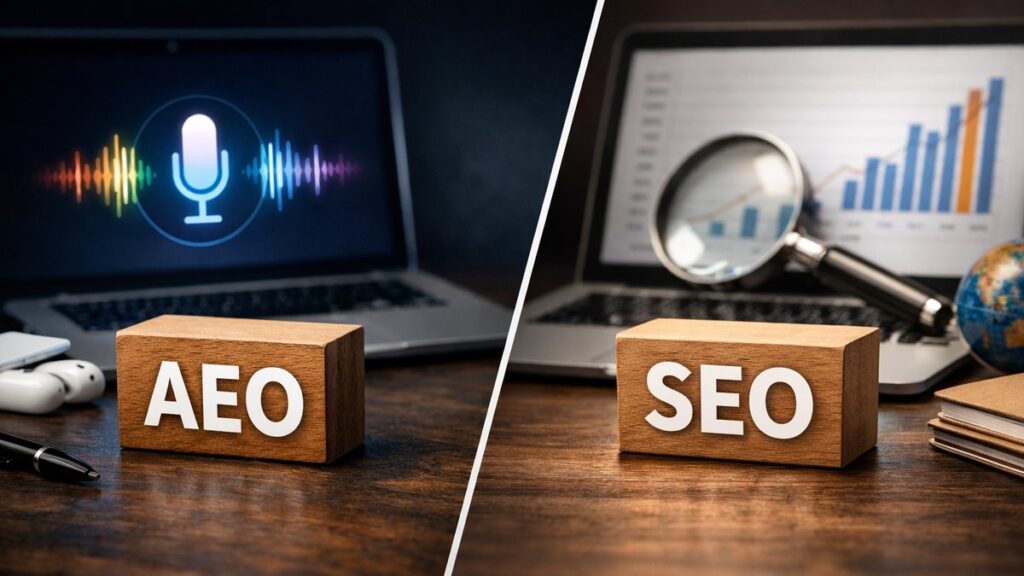
AEO vs SEO: goals, metrics, and content formats compared
AEO vs SEO is one of the most debated topics in digital marketing today — and for good reason. Search Engine Optimization has shaped how content is discovered for decades, while Answer Engine Optimization represents a fundamental shift in how users interact with information. Start by understanding what answer engine optimization is before diving into how the two disciplines diverge, overlap, and ultimately reinforce each other.
Core differences between AEO and SEO
Both disciplines share the same starting point — quality content — but their objectives, success metrics, and content strategies diverge significantly.
| Dimension | SEO | AEO |
|---|---|---|
| Primary goal | Rank high in search result pages | Be the direct answer to a user query |
| User intent focus | Broad: navigational, informational, transactional | Narrow: conversational, question-based queries |
| Content format | Long-form articles, landing pages, category pages | Concise answers, structured data, FAQs, lists |
| Key metrics | Organic traffic, click-through rate, rankings | Featured snippets, voice answer rate, zero-click visibility |
| Ranking factors | Backlinks, page speed, keyword density, UX signals | Schema markup, answer clarity, entity relevance, E-E-A-T |
| Optimization target | Search engine algorithms | AI assistants, voice engines, and featured snippet boxes |
| Result type | Blue link in SERP | Direct spoken or displayed answer |
How each discipline measures success
SEO metrics to track
- 📈 Organic sessions and pageviews
- 🔗 Number and quality of backlinks
- 🖱️ Click-through rate (CTR) from SERPs
- ⏱️ Core Web Vitals scores
- 📍 Keyword ranking positions
- 🔄 Crawl coverage and indexation rate
AEO metrics to track
- 🎯 Featured snippet ownership rate
- 🗣️ Voice search answer frequency
- 🤖 AI-generated answer citations
- 👁️ Zero-click impression share
- 📦 Rich result appearances (FAQ, How-To)
- 🧩 Entity recognition in knowledge panels
Content formats: what each strategy demands
Content built for SEO
- Comprehensive long-form guides (1,500+ words) that cover a topic in depth
- Pillar pages and topic clusters that establish topical authority
- Optimized meta tags, title tags, and internal linking structures
- High-quality backlink-worthy assets such as original research and infographics
- Technically sound pages with fast load times and mobile-first design
Content built for AEO
- Direct, concise answers placed within the first 40–60 words of a section
- Structured data markup (Schema.org) for FAQPage, HowTo, and Article types
- Question-and-answer formatting that mirrors conversational queries
- Clear entity definitions that help AI models understand context
- Authoritative signals aligned with E-E-A-T (Experience, Expertise, Authoritativeness, Trust)
Ranking factors: SEO vs AEO side by side
| Ranking factor | Weight in SEO | Weight in AEO |
|---|---|---|
| Backlink profile | Very high | Moderate (credibility signal) |
| Keyword optimization | High | Moderate (semantic clarity matters more) |
| Schema markup | Moderate | Very high |
| Answer clarity and brevity | Low | Very high |
| Page speed / Core Web Vitals | High | Moderate |
| E-E-A-T signals | High | Very high |
| Entity and topic relevance | Moderate | Very high |
| Conversational query match | Low | Very high |
Why AEO cannot exist without SEO
A common misconception is that AEO replaces SEO. In reality, SEO is the structural foundation that makes AEO possible. Read more about why SEO forms the non-negotiable base layer of AEO — without technical health, domain authority, and indexed content, no page can compete for featured snippets or AI-generated answers.
✅ What SEO provides to AEO
- Crawlable, indexable pages that answer engines can access
- Domain authority that signals trustworthiness to AI models
- Technical infrastructure (site speed, mobile UX) required for snippet eligibility
- Topical depth that establishes entity relevance across a content cluster
✅ What AEO adds to an SEO strategy
- Visibility in zero-click environments where traditional blue links are absent
- Presence in voice and AI-powered search interfaces
- Higher perceived authority when a brand becomes the cited source
- Improved user experience through clearer, more direct content structures
How Draftto produces content optimized for both AEO and SEO
Draftto is built on the premise that no content team should have to choose between ranking in traditional search and winning answer-engine placements. Its generation engine applies both frameworks simultaneously.
- 🏗️ Dual-layer structure: articles are scaffolded with SEO-grade heading hierarchies and topical depth, while each section opens with an AEO-ready concise answer block.
- 🧱 Schema-ready output: Draftto embeds structured data recommendations (FAQPage, Article, HowTo) directly into the content workflow, reducing implementation friction.
- 🔍 Semantic keyword mapping: the platform identifies primary keywords for ranking purposes alongside the conversational query variants that answer engines prioritize.
- 📐 E-E-A-T alignment: every article is generated with author authority signals, factual framing, and source-quality guidelines baked into the prompt architecture.
- 🔗 Silo-aware internal linking: content is produced within a cluster logic that reinforces topical authority — a core SEO signal that also strengthens AEO entity relevance.
The result is a single article that competes for conventional organic rankings while simultaneously being structured for featured snippets, voice answers, and AI-generated responses — covering the full spectrum of AEO vs SEO requirements without duplicating effort.