
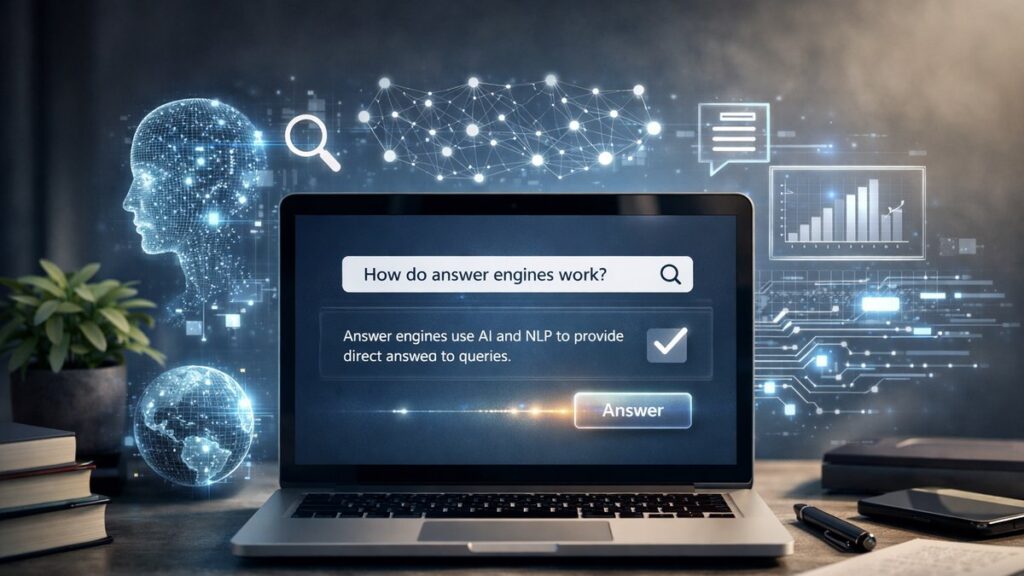
The technology powering AI answer engines
Understanding how answer engines work is essential for any content strategy that aims to remain visible in a world where search results increasingly skip the click. AI answer engines combine natural language processing, knowledge graphs, entity recognition, and generative AI to deliver direct responses — reshaping zero-click search behavior and raising the stakes for how content is structured and served. To get the full picture of answer engine optimization, it helps to first understand the machinery running underneath.
Natural language processing: how machines understand questions
Natural language processing (NLP) is the core technology that allows answer engines to interpret human questions — not just keywords. Rather than matching strings of text, NLP models parse intent, context, syntax, and semantics.
Key NLP capabilities in answer engines
| Capability | What it does |
|---|---|
| Intent detection | Identifies whether the user wants information, navigation, or a transaction |
| Semantic parsing | Understands meaning beyond literal word choice |
| Coreference resolution | Links pronouns and references across a query or document |
| Sentiment analysis | Detects tone and context to refine the response |
| Named entity recognition | Extracts people, places, organizations, and concepts from text |
These capabilities work together so that when a user asks a complex or conversational question, the engine can resolve ambiguity and select the most relevant passage from its indexed sources.
Knowledge graphs and entity recognition
Behind every answer engine is a structured model of the world — a knowledge graph. This graph maps entities (people, products, places, concepts) and the relationships between them, allowing the engine to reason about connections rather than simply retrieve documents.
How entities are identified and used
- ✦ Named entity recognition (NER) tags nouns in content as specific, classifiable objects
- ✦ Entity disambiguation resolves which “Apple” or “Mercury” a query refers to
- ✦ Relationship mapping connects entities (e.g., “founder of”, “located in”, “part of”)
- ✦ Confidence scoring ranks how certain the engine is about an entity match
- ✦ Schema markup on web pages helps engines confirm and classify entities correctly
Content that clearly defines its entities and uses structured data is significantly more likely to be pulled into answer engine responses. This is why semantic clarity — not keyword density — drives visibility in AI-powered search.
Generative AI summaries and how they synthesize content
Modern answer engines no longer just extract snippets — they generate synthesized responses using large language models (LLMs). These models read multiple sources and produce a coherent, original answer that may or may not cite the underlying pages.
⚙ How generative summaries are built
- Multiple web sources are retrieved and ranked
- The LLM reads and weighs each source by relevance
- A new response is generated — not copied
- Citations may or may not be included
- The response adapts to the conversational context
📌 What makes content “generative-friendly”
- Clear, direct answers near the top of the page
- Structured formatting (lists, tables, headers)
- Short, self-contained paragraphs
- Authoritative language with factual precision
- Schema markup that confirms page topic and type
Zero-click search behavior and its impact on content strategy
Zero-click search occurs when a user gets their answer directly on the results page without visiting any website. Answer engines accelerate this behavior by surfacing complete responses to informational queries. The implications for publishers and marketers are significant.
Zero-click: risks and opportunities side by side
| Risk | Opportunity |
|---|---|
| Reduced organic traffic for informational content | Brand visibility through featured answers and citations |
| Content consumed without a visit or attribution | Authority signals built when engines cite your source |
| Difficulty tracking impressions vs. clicks | Increased trust from appearing as the “chosen” source |
| Lower ad revenue on informational pages | Conversion opportunities for transactional follow-ups |
The winning strategy is not to fight zero-click search, but to structure content so that your brand appears within the answer itself — as the authoritative source the engine chooses to synthesize or cite.
How Draftto formats content for answer engines
Producing content that answer engines can read, parse, and trust requires a deliberate approach to structure and semantics. Draftto is built specifically to generate articles that meet these technical requirements by default.
Draftto’s answer-engine-friendly features
- Automatic use of structured formatting — tables, lists, and defined sections — that NLP models can parse cleanly
- Entity-aware writing that names and contextualizes key concepts for knowledge graph alignment
- Schema-ready output compatible with structured data markup for page type, author, and topic
- Direct-answer placement: key responses appear early in the content, matching how answer engines retrieve passages
- Semantic heading hierarchy that signals topic relationships across the document
- Machine-readable HTML output (Gutenberg blocks) that reduces friction between content and engine indexing
Draftto does not simply optimize for keywords — it structures each article so that AI systems can identify its purpose, extract its core answers, and rank it as a trustworthy source within the answer engine ecosystem. For teams navigating how answer engines work and how zero-click search is reshaping visibility, Draftto removes the manual complexity of AEO-compliant content production.