
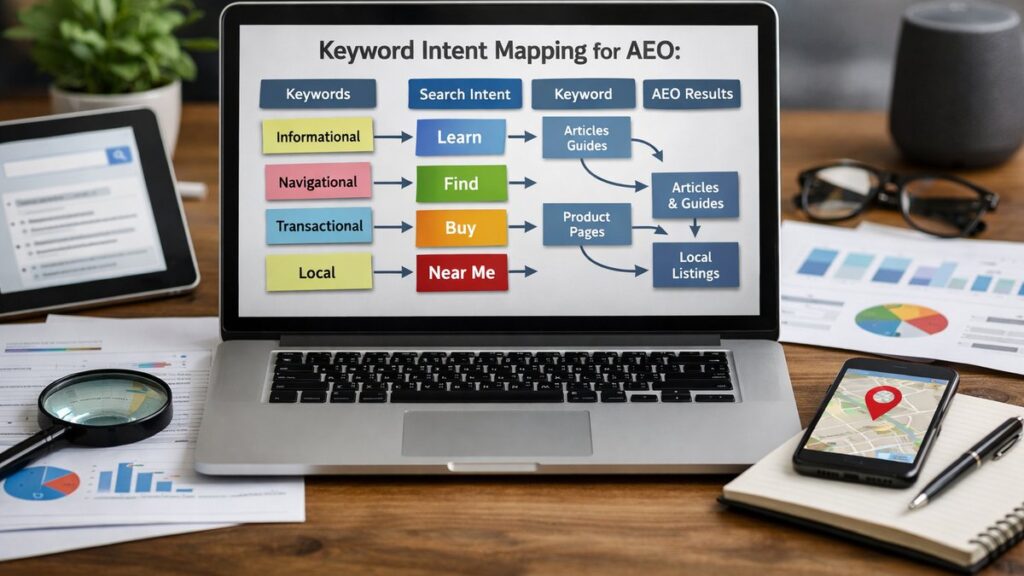
Keyword intent mapping for AEO: aligning queries with direct answers
Keyword intent mapping for AEO is the practice of connecting what users are truly asking with the type of answer an answer engine is designed to deliver. While traditional SEO focuses on ranking pages, Answer Engine Optimization (AEO) demands a deeper layer of intent analysis — one that identifies not just what people search for, but the exact format and directness of the response they expect. Understanding how SEO keyword strategy feeds into AEO is essential before mapping intent signals to content formats that satisfy both search engines and AI-powered answer systems.
The three intent types and how they translate to AEO
Every search query carries an underlying intent signal. Mapping these signals correctly determines whether your content gets cited as a direct answer or simply ranks as a blue link.
| Intent type | User goal | AEO content format | Example query |
|---|---|---|---|
| Informational | Learn or understand something | Definition boxes, step-by-step guides, FAQ-style answers | “How does photosynthesis work?” |
| Navigational | Reach a specific resource or brand | Structured brand summaries, entity-rich descriptions | “Draftto AI content tool” |
| Transactional | Take an action or make a decision | Comparison tables, pros/cons lists, concise value statements | “Best AI writing tools for SEO” |
Answer engines prioritize informational queries most heavily because they align naturally with direct-response formats. However, transactional and navigational queries are increasingly surfaced as structured answers when content is properly optimized.
Question-based keywords: the bridge between SEO and AEO
Conversational and question-based keywords occupy the critical overlap between traditional search optimization and answer engine expectations. These queries mirror how people speak — to voice assistants, AI chatbots, and smart devices — and they demand concise, authoritative replies.
Why question-format queries outperform head terms in AEO
- They signal clear informational intent, making answer extraction straightforward for AI systems.
- They map directly to featured snippets, People Also Ask boxes, and voice search responses.
- They carry lower competition than broad head terms while delivering higher contextual relevance.
- They align with how large language models process and retrieve knowledge during inference.
- They allow content creators to structure responses in the exact format answer engines prefer.
Identifying high-value question keywords for AEO
✅ Strong AEO keyword signals
- Queries starting with “how,” “what,” “why,” “when,” “which”
- Long-tail phrases with clear subject + action structure
- Conversational queries that mirror spoken language
- Keywords with existing featured snippet presence
❌ Weak AEO keyword signals
- Single-word head terms with ambiguous intent
- Brand-only navigational queries without supporting context
- Highly transactional keywords without informational framing
- Vague terms that require significant disambiguation
Mapping intent to AEO content structures
Once intent is classified, the next step is selecting the content format that answer engines are most likely to extract and cite. Different intent types demand different structural approaches.
Informational intent → structured knowledge formats
- Open with a one-to-two sentence direct answer that restates the query as a declarative statement.
- Follow with supporting context organized under descriptive subheadings.
- Use numbered lists for processes and unordered lists for characteristics or options.
- Include a summary table when multiple entities or concepts are being compared.
Transactional intent → decision-enabling formats
- Lead with a clear recommendation or value comparison rather than background explanation.
- Structure information as side-by-side comparisons or pros/cons breakdowns.
- Include specific criteria that help users evaluate options quickly.
- Reinforce with concise call-to-action language aligned to the user’s decision stage.
Navigational intent → entity-rich brand content
- Build content around well-defined entities (brands, tools, people, products) with consistent naming.
- Use structured data markup to reinforce entity associations for AI crawlers.
- Provide concise, factual descriptions that knowledge panels and AI summaries can extract directly.
How Draftto detects intent signals and generates AEO-aligned structures
Draftto’s AI goes beyond standard keyword research by analyzing intent signals embedded within search queries before generating any content structure. Rather than treating all keywords equally, Draftto classifies each target term by intent type and automatically selects the article format most likely to satisfy answer engine expectations.
🔍 Intent detection layer
Draftto analyzes query syntax, semantic context, and SERP patterns to classify whether a keyword carries informational, navigational, or transactional intent — before a single word of content is written.
🏗️ Structure generation layer
Based on the detected intent, Draftto automatically scaffolds the article with the heading hierarchy, list formats, table placements, and opening answer patterns that answer engines are built to extract and cite.
This means content produced with Draftto is not just optimized for ranking — it is architected to be selected as a direct answer. The tool bridges the gap between keyword intent mapping for AEO and practical content production, eliminating the guesswork that typically separates well-ranked pages from cited answers.
Key principles for effective intent mapping in an AEO strategy
| Principle | Why it matters for AEO |
|---|---|
| Match format to intent before writing | Answer engines reward structural predictability — the right format signals the right content type |
| Prioritize question-based keyword clusters | Conversational queries align with how AI answer systems retrieve and surface information |
| Open every article with a direct answer | Frontloading the answer increases extraction probability for featured snippets and AI summaries |
| Use semantic variations, not keyword repetition | Answer engines evaluate topical authority through breadth of related terminology, not density |
| Treat SEO structure as the AEO foundation | Heading hierarchy, schema markup, and crawlability remain prerequisites for any answer optimization |