
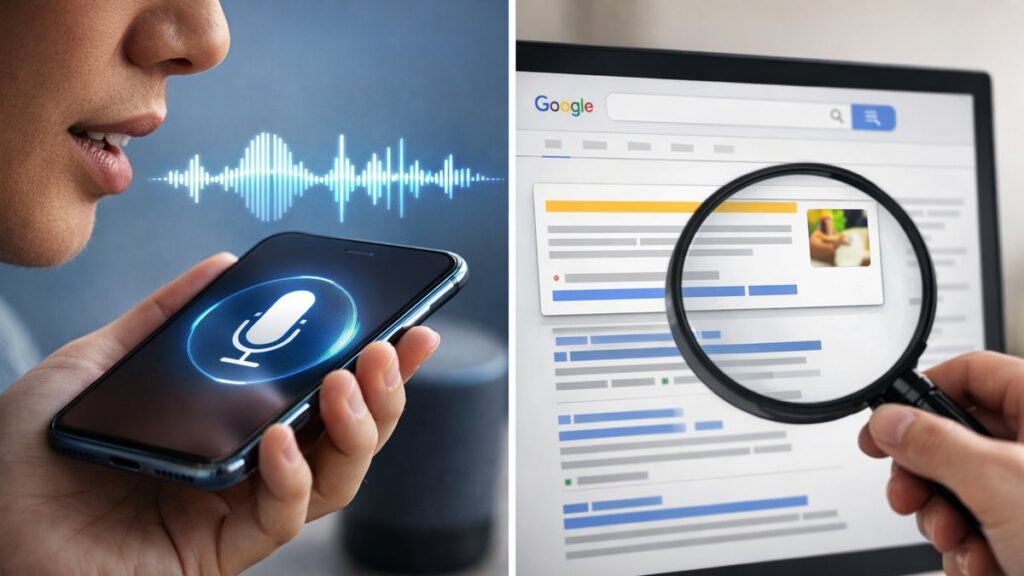
Why voice search and featured snippets are inseparable
The connection between voice search and featured snippets is not coincidental — it is structural. When a voice assistant answers a spoken query, it almost always reads the content that occupies the featured snippet position in Google’s search results. Understanding this overlap is the foundation of any effective Answer Engine Optimization (AEO) strategy, and mastering it means capturing two high-visibility channels with a single well-crafted piece of content.
The mechanics of the voice-snippet connection
Voice assistants do not crawl the web independently in real time. They rely on the structured signals that search engines have already surfaced. Here is how the pipeline works:
- A user asks a conversational question via voice.
- The voice engine queries the underlying search index.
- The search engine identifies the most authoritative, concise answer — typically the featured snippet.
- The assistant reads that snippet text aloud as the spoken response.
This means winning the featured snippet is, in most cases, synonymous with winning the voice answer. The two outcomes share the same trigger: a query phrased as a question, and a page that answers it with precision and structure.
Types of featured snippets most likely to become voice answers
| Snippet type | Voice answer likelihood | Best content format |
|---|---|---|
| Paragraph snippet | Very high | 40–60 word direct answer |
| Ordered list snippet | High | Step-by-step instructions |
| Unordered list snippet | Medium | Feature or comparison lists |
| Table snippet | Low | Comparative data (rarely read aloud) |
Paragraph snippets dominate voice results because they translate naturally into spoken language. Lists can be read aloud but are less fluid. Tables are rarely converted into voice answers at all.
Combined optimization tactics for voice search and featured snippets
Structure your answers for instant comprehension
✅ Do this
- Place the direct answer in the first 1–2 sentences after the heading
- Keep answer paragraphs under 60 words
- Use the question as part of the heading or subheading
- Write in plain, conversational language
- Use schema markup (FAQPage, HowTo, Speakable)
❌ Avoid this
- Burying the answer deep in a long paragraph
- Using jargon or technical abbreviations without explanation
- Structuring content around keywords alone, not intent
- Ignoring mobile and page speed signals
- Writing for desktop reading patterns only
Target conversational, long-tail queries
Voice queries are typically longer and more natural than typed searches. Optimizing for them means anticipating how a real person would phrase a question out loud — not how a user would type a few keywords into a search bar. For a deeper look at how this shapes an entire content strategy, explore the voice search AEO strategy hub, which maps out the full conversational optimization framework.
- Use who, what, when, where, why, and how as natural heading starters
- Match the query length of natural speech (7–10 words on average)
- Address follow-up questions in the same content cluster
- Align with local intent signals where the topic demands proximity
Speakable schema: signaling content for audio delivery
The Speakable schema markup tells search engines which sections of a page are best suited for text-to-speech output. While adoption is still growing, implementing it sends a clear intent signal that your content is optimized for voice delivery — a meaningful advantage in competitive AEO environments.
- Apply Speakable markup to introductory paragraphs and key answer blocks
- Pair with FAQPage or HowTo schema for richer structured data coverage
- Ensure marked sections are self-contained and intelligible when read aloud in isolation
How to audit your content for dual-channel AEO readiness
- Identify existing featured snippet opportunities — use search console data to find queries where your pages rank in positions 2–5 for question-based terms.
- Check answer placement — confirm the direct answer appears within the first 100 words of the relevant section, not after extended preamble.
- Evaluate sentence length and readability — run key paragraphs through a readability tool; aim for a reading level accessible to a general audience.
- Validate structured data — use Google’s Rich Results Test to confirm schema implementation is error-free.
- Test the spoken experience — use a voice assistant to query your target questions and listen critically to how the answer sounds when read aloud.
How Draftto structures content for this dual-channel opportunity
Draftto is built around the principle that every article should be answer-first by default. Its content generation framework automatically applies the structural patterns that correlate most strongly with featured snippet selection — concise opening answers, question-aligned headings, short paragraph blocks, and schema-ready formatting — without requiring manual intervention on each piece.
🎯 Snippet optimization built in
Draftto generates content with answer paragraphs calibrated to the length and structure that search engines reward with featured snippet positions, directly targeting the voice search and featured snippets overlap.
🔊 Voice-ready language patterns
Output is written in natural, conversational prose that translates cleanly into spoken audio — a critical requirement when voice assistants read snippet content aloud to end users.
For content creators focused on AEO, this matters because the cost of optimization is typically in the editing and restructuring phase. Draftto eliminates that friction by producing copy that is already aligned with the technical and linguistic requirements of both featured snippets and voice answer selection. A thorough breakdown of those requirements is available in the guide on optimizing the featured snippets that voice engines read aloud.
The compounding advantage of targeting both channels together
Brands that treat voice search and featured snippets as a unified target — rather than two separate tactics — benefit from a compounding visibility effect. A single optimized content block can simultaneously occupy the zero-position in visual search results and serve as the spoken answer delivered by voice assistants across multiple devices. This dual-channel presence amplifies reach without requiring proportionally more content investment, making it one of the highest-leverage moves available within a modern AEO strategy.